Right now, somewhere on a forum you’ll never visit, there’s a good chance someone is offering a list of email-and-password combinations that belong to your employees. Not because your company was hacked. Because somewhere else was — a service one of your staff signed up for with their work email — and the fallout rolled downhill to you.
Most companies have no idea. They’re watching their own front door while their keys are being copied in a building across town.
👉 New to ASM and CTI? Start with our plain-English primer: What is ASM? What is CTI? And Why You Need Both →
Where the Leaks Actually Come From
The phrase “dark web” conjures up hooded figures and elaborate hacks. The reality is more mundane — and far more common.
Most of what leaks about your company never involves your company being breached at all:
- Third-party breaches. An employee used their work email to sign up for a marketing tool, a fitness app, a forum, a conference site. That service got breached. Now their work email — and often the password they reused — is in a dump being traded online.
- Infostealer malware. A laptop (sometimes a personal one) gets infected with software that quietly harvests every saved password in the browser. Those bundles, called “stealer logs,” are sold in bulk and include the exact login URLs.
- Misconfigured cloud storage. A spreadsheet, a backup, a customer export left in a storage bucket with no password. It gets found, copied, and listed.
- Accidental exposure. Credentials hard-coded into a public code repository. An internal document attached to a public support ticket. A database left open to the internet for “just a few days.”
None of these announce themselves. There’s no alarm, no email, no breach notification. The data simply appears in places you’re not looking — and stays there.
Why Leaked Credentials Are So Dangerous
A single leaked password might sound minor. It isn’t — for one reason: people reuse passwords.
When an attacker buys a dump of leaked credentials, they don’t manually try each one. They feed the whole list into automated tools that test those email-and-password pairs against hundreds of other services — your email portal, your VPN, your cloud admin console, your payroll system. This is called credential stuffing, and it’s one of the most common ways companies get breached today.
The math is brutally in the attacker’s favor. They don’t need every password to work. They need one. One employee who used the same password for a breached forum that they also use for the company VPN, and the attacker walks straight in through the front door — with valid credentials, looking exactly like a legitimate login.
No malware. No exploit. No alarm. Just a login.
What Else Is Out There Besides Passwords
Credentials are the headline, but they’re not the whole story. The same threat intelligence sources that surface leaked passwords also reveal:
- Your company being discussed or targeted in attacker forums and marketplaces — sometimes before an attack, when access to your network is being advertised for sale.
- Customer or employee data from a third-party breach that included your records.
- Exposed API keys and tokens that grant access to your cloud services or payment systems.
- Your domains and IP ranges showing up on blacklists — a sign your infrastructure may already be compromised and sending spam or hosting malicious content. (We wrote about that specific problem in Your Company’s IP Reputation May Be Damaged →.)
Each of these is a piece of the picture an attacker builds before they ever touch you. The uncomfortable truth is that they often know more about your exposure than you do — because they’re looking, and you’re not.
This Is What CTI Is For
This is exactly the gap Cyber Threat Intelligence (CTI) exists to close.
Where Attack Surface Management (ASM) tells you what you own on the internet, CTI tells you what’s being said and sold about it — continuously monitoring breach dumps, stealer logs, paste sites, dark web marketplaces, forums, and blacklists for any mention of your organization, your domains, your people, or your data.
The two work as a pair. ASM finds the exposed login portal; CTI finds the leaked password that opens it. One without the other leaves half the door unguarded. That’s why Helios by Isaphia treats them as a single picture: your external footprint and everything attackers already know about it, in one place.
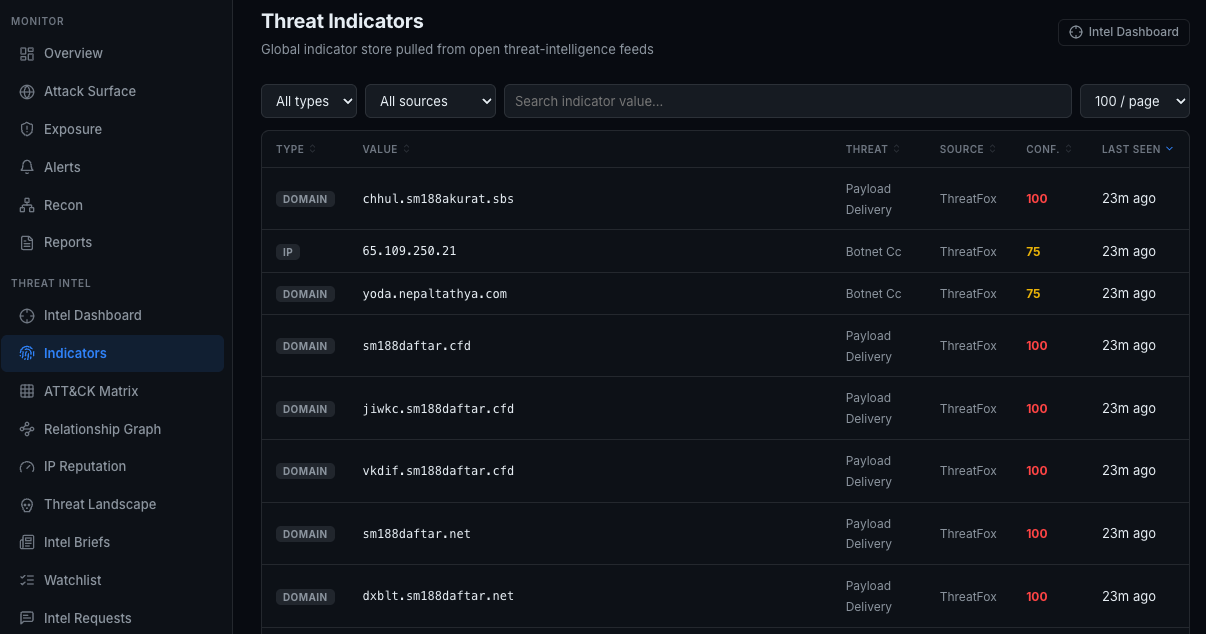 The raw material of CTI: a continuously updated store of indicators from threat feeds — which only becomes useful when it’s matched against what you actually own.
What You Should Do
1. Find out what’s already leaked
You can’t react to what you can’t see. The first step is a simple one most companies skip: actually check whether your domains, employee emails, and credentials are already circulating. Most are surprised by what comes back.
2. Force a reset on exposed accounts
Any credential that shows up in a leak should be treated as compromised — full stop. Reset it, and reset it everywhere that password may have been reused. This is the single highest-impact action you can take in an afternoon.
3. Turn on MFA everywhere it matters
Multi-factor authentication is what turns a leaked password from a break-in into a non-event. If a stolen credential still needs a second factor the attacker doesn’t have, the leak is far less useful to them. Prioritize email, VPN, and any cloud admin console.
4. Kill password reuse
Most leaked-credential attacks succeed because of reuse. A password manager and a clear policy against reusing work passwords on outside services removes the mechanism the entire attack depends on.
5. Make the monitoring continuous
Leaks don’t happen on a schedule. A one-time check tells you about today; new dumps surface every week. Ongoing monitoring is the difference between learning about a leak when you find it versus when an attacker does.
The Bottom Line
The data is already out there for most companies — the only variable is who finds it first. If it’s you, a leaked password is a five-minute reset. If it’s an attacker, it’s the first step of a breach that looks, from the inside, exactly like a normal day.
You don’t get to choose whether you’re exposed. You only get to choose whether you’re watching.
How Isaphia Helps
Isaphia ASM + CTI continuously monitors breach dumps, stealer logs, dark web marketplaces, and blacklists for any sign of your organization — leaked credentials, exposed data, damaged IP reputation, mentions in attacker forums — and ties it directly to the external attack surface those leaks put at risk.
You can see what’s already leaking about your company right now, for free. No credit card. No sales call. Sign up and find out what attackers may already know.
👉 Start your free trial at heliosuite.io/signup
Isaphia is an attack surface management and threat intelligence platform that helps organizations discover, monitor, and protect their external digital footprint — before attackers exploit it.