Most businesses focus on what they can see. Firewalls. Antivirus. Patched software. But there’s a silent threat hiding in plain sight — your IP reputation — and by the time you notice it, the damage is already done.
👉 New to ASM and CTI? Start with our plain-English primer: What is ASM? What is CTI? And Why You Need Both →
What Is IP Reputation?
Every device that connects to the internet does so through an IP address. Over time, those IP addresses build a reputation — good or bad — based on the traffic and behavior associated with them.
Threat intelligence feeds, spam databases, and security vendors constantly monitor and score IP addresses globally. If an IP gets flagged, it gets added to blacklists and blocklists that thousands of organizations and security tools rely on automatically.
Your emails, your traffic, your services — all judged by that score.
How Does an IP Get a Bad Reputation?
This is where most businesses are surprised. You don’t have to do anything wrong.
Here’s how it happens:
1. IP History You Didn’t Create
IP addresses get recycled. If your cloud provider or ISP assigned you an IP that a previous user abused — spamming, hosting malware, running botnets — that history follows the IP, not the previous owner. You inherited the damage.
2. A Compromised Device on Your Network
One infected laptop. One misconfigured server quietly sending spam. One employee clicking the wrong link. A single compromised device can get your entire IP range flagged before your security team sees a single alert.
3. Shadow IT and Unknown Assets
Does your security team know every IP associated with your organization? Cloud instances spun up by developers, forgotten test environments, third-party vendors operating on your behalf — these all represent IP addresses tied to your name that you may not be monitoring.
4. Misconfigurations
Open relays, misconfigured mail servers, and poorly secured APIs can be exploited by external attackers to send traffic through your infrastructure — getting you blacklisted for activity you never intentionally performed.
What Actually Happens When Your IP Reputation Is Damaged?
The consequences are real and they compound over time:
- Your emails stop reaching inboxes. Sales outreach, customer communications, invoices — silently landing in spam folders. You never get a bounce notification. You just never get a reply.
- Your traffic gets blocked. Security tools at your partners, customers, and vendors automatically block traffic from flagged IPs. Integrations break. API calls fail. Support tickets pile up with mysterious errors.
- Your credibility takes a hit. Security-conscious organizations run reputation checks on vendors. A flagged IP range can quietly cost you deals you never knew you lost.
- Attackers take notice. A damaged reputation can signal to threat actors that your infrastructure is poorly monitored — making you a more attractive target.
The Worst Part — There Is No Alarm
Unlike a data breach or a ransomware attack, IP reputation damage doesn’t announce itself. There’s no alert. No notification. No obvious moment where something goes wrong.
You find out when a customer asks why your emails look like spam. You find out when a partner says their firewall is blocking your traffic. You find out when someone else finds it for you — and by then, the damage has been accumulating for weeks or months.
What You Should Do Right Now
1. Discover every IP associated with your organization
Start with what you know — your office networks, your cloud infrastructure, your hosting providers. Then go deeper. What about your subsidiaries? Your remote work infrastructure? Your third-party vendors?
2. Check them against threat intelligence feeds and blacklists
There are dozens of major blacklists and threat intelligence databases that track IP reputation. Each one has different data, different sources, and different criteria. A proper check covers all of them — not just one or two.
3. Investigate every flagged IP — even if you didn’t cause it
“We didn’t do it” is not a defense when your infrastructure is the one flagged. Investigate the source, remediate the issue, and submit removal requests to the relevant blacklists.
4. Don’t make this a one-time audit
IP reputation changes constantly. New threats emerge. New IPs get associated with your organization. New infrastructure gets spun up. Continuous monitoring is the only way to stay ahead of damage before it impacts your business.
How Isaphia Helps
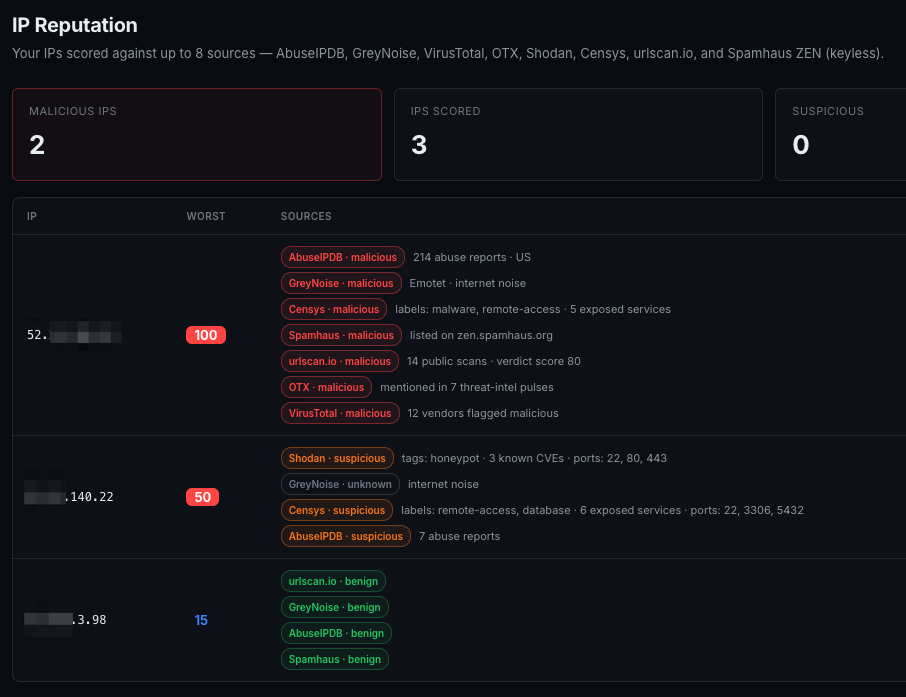
Isaphia’s attack surface management and threat intelligence platform does this automatically. We discover the IPs associated with your organization — including ones you may not know about — and continuously monitor them against major threat intelligence feeds and blacklists.
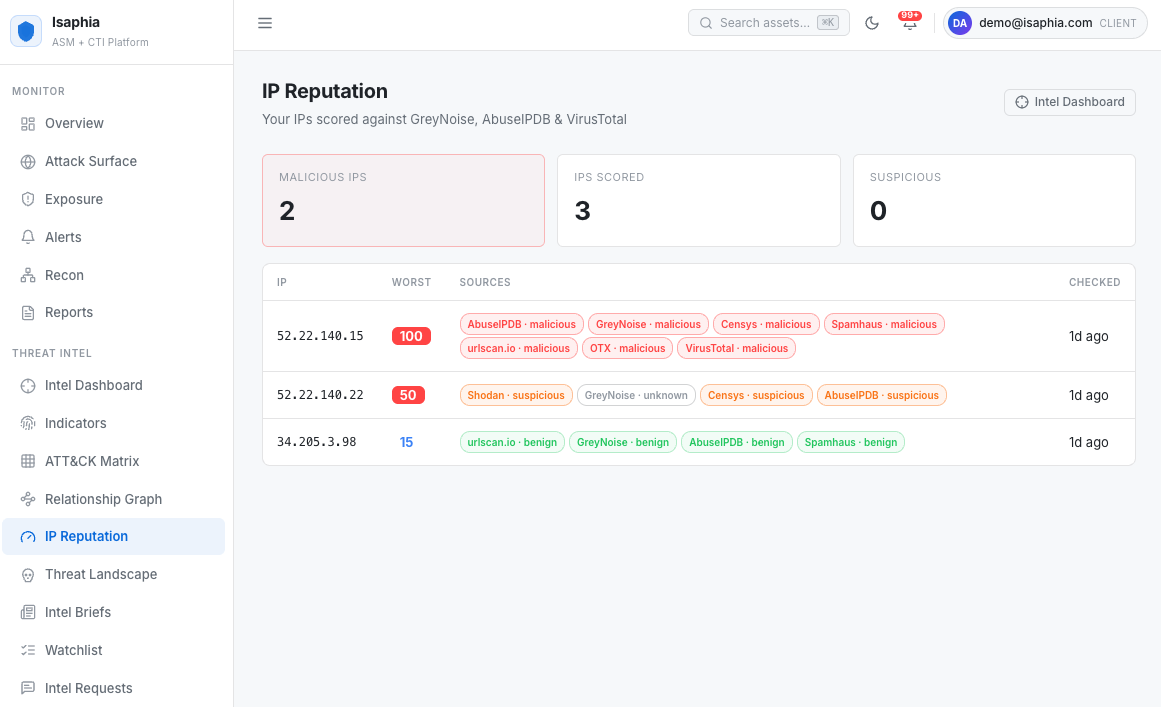 Every IP you own, scored against GreyNoise, AbuseIPDB, VirusTotal, Spamhaus, and more — flagged the day it turns bad, not the day a customer complains.
When something gets flagged, you find out immediately. Not when a customer tells you. Not when a deal falls through. Immediately.
The best part — you can see your own IP reputation right now, for free. No credit card. No sales call. Sign up and see what’s out there associated with your organization in minutes.
👉 Start your free trial at app.isaphia.com/signup
Isaphia is an attack surface management and threat intelligence platform that helps organizations discover, monitor, and protect their external digital footprint — before attackers exploit it.