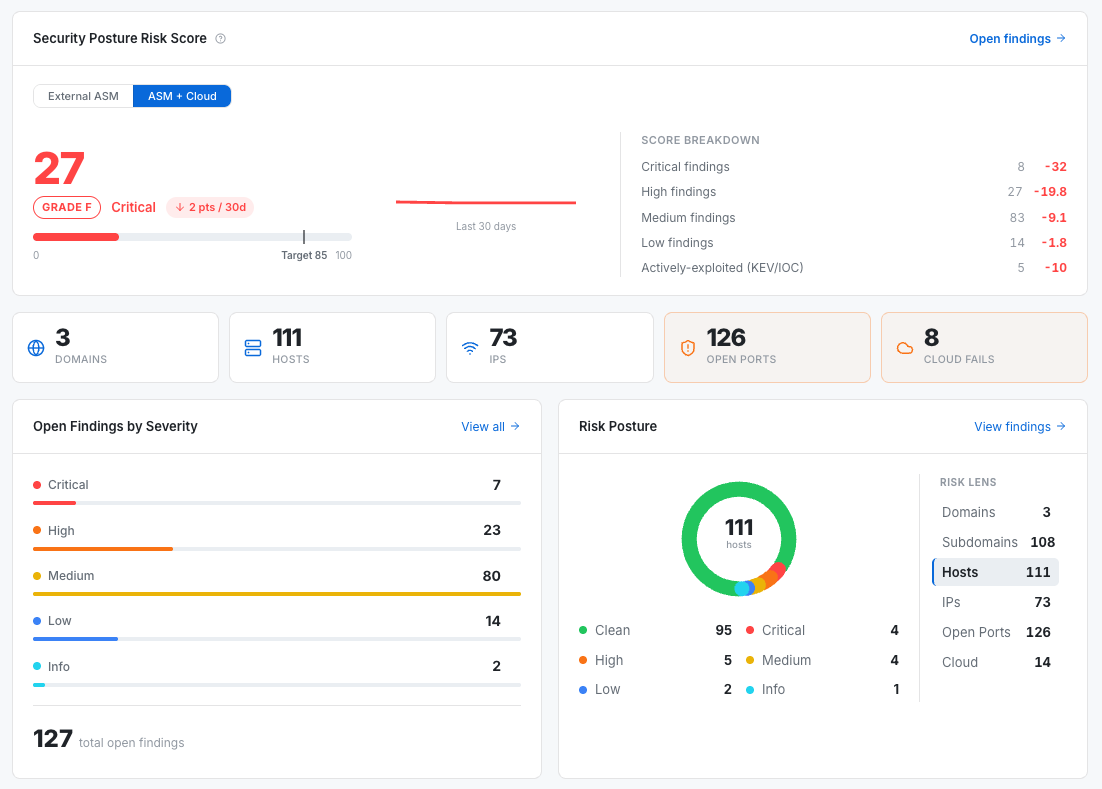
A real attack is almost never one event. It’s a chain, and each link lives in a different blind spot:
An employee’s password leaks in a third-party breach and goes up for sale on the dark web. An attacker buys it and tries it against a login portal on a subdomain nobody remembered owning. It works. Inside the network, they find a file server still speaking a protocol from 2003 and pivot across machines until they reach a cloud storage bucket that someone — years ago, temporarily, for a demo — set to public.
Four links. Four different categories of security tooling. And in most organizations, four separate consoles that have never heard of each other. Each tool sees its own link clearly and honestly reports “nothing critical here” — while the chain runs straight through all of them.
That’s the problem Helios by Isaphia is built to solve. Helios is a unified exposure-management platform: one place that shows you everything an attacker could reach — your internet-facing footprint, the inside of your network, the intelligence attackers already hold on you, and the configuration of your cloud. Not “another scanner,” but the connected picture: the leaked credential, the forgotten subdomain, the legacy system, and the open bucket, in one dashboard, correlated against the same inventory of what you actually own.
👉 New to this space entirely? Our plain-English primer is a good place to start: What is ASM? What is CTI? And Why You Need Both →
The Four Modules
External ASM — the outside-in view. It continuously discovers every internet-facing asset your organization owns — domains, subdomains, servers, login portals, certificates, email configuration — including the ones nobody remembered to put on a list. This is the attacker’s way in, and it’s fully agentless: you give it a seed domain and it does the rest.
Internal ASM — the inside view. Lightweight collectors map what’s actually running behind your firewall: every device, every service, and the legacy weaknesses attackers use to spread — EternalBlue, BlueKeep, SMBv1, plaintext logins — each tied automatically to the CVE that explains it. This is the attacker’s way around.
CTI — the intelligence view. Threat intel feeds, dark-web leaks, and IP reputation — but matched against your real inventory, not delivered as fifty thousand generic indicators a week. If a credential tied to your domain shows up for sale, or an IP you own lands on a blocklist, you know. This is what the attacker already knows.
CSPM — the cloud view. Cloud Security Posture Management continuously audits your AWS, Azure, and GCP accounts for the misconfigurations attackers hunt for: public storage buckets, databases reachable from the internet, over-privileged identities, disabled logging. It’s agentless and read-only — you grant read access, and Helios reviews your cloud the way an auditor and an attacker both would, with every check mapped to CIS Benchmarks and the compliance frameworks your auditors care about. This is the attacker’s favorite modern way in.
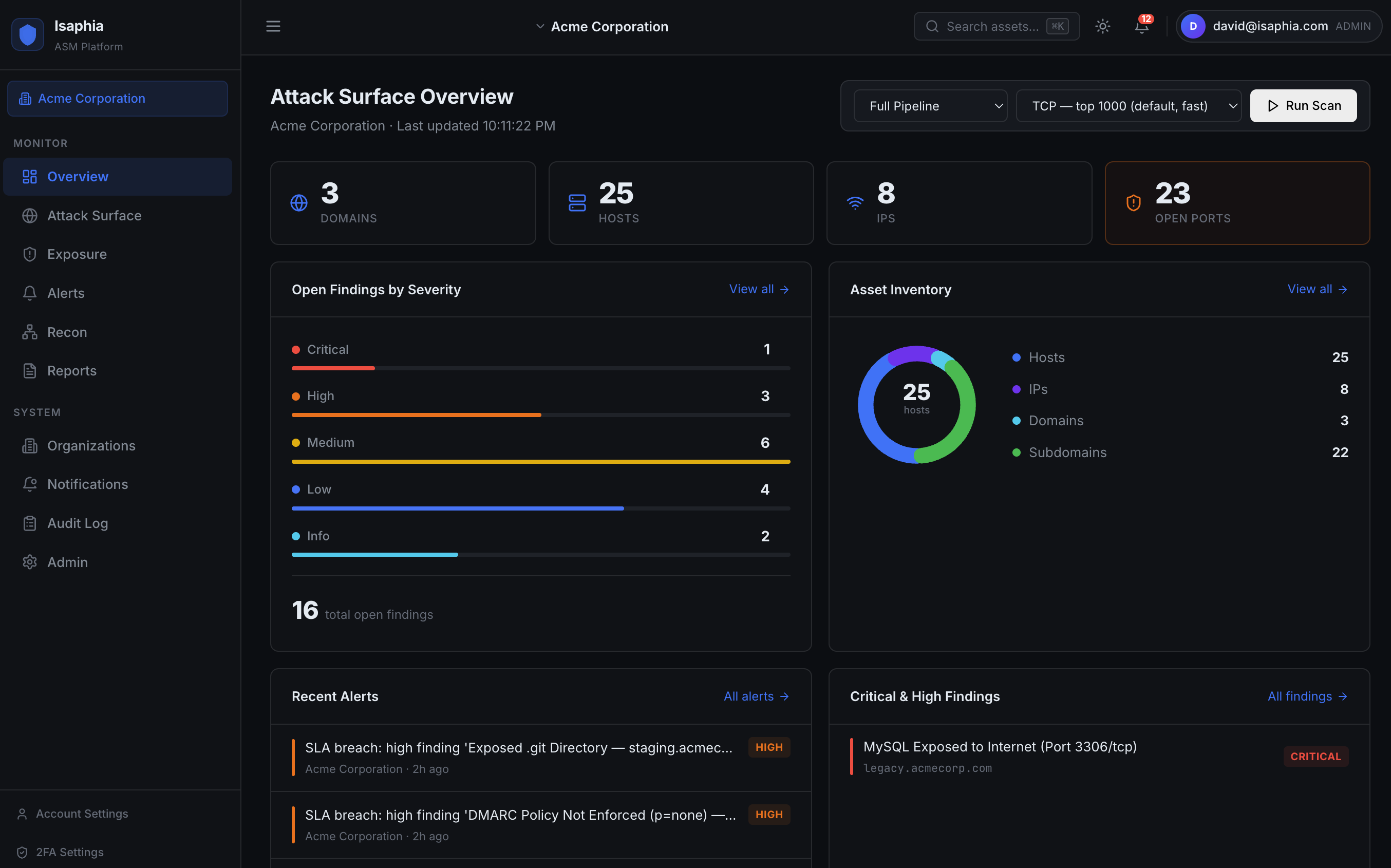 The Helios overview: what you own, what’s open, and what needs attention first — one screen, one risk score.
What a Platform Means in Practice
Plenty of vendors staple products together and call the bundle a platform. Here’s what the word actually buys you in Helios:
- One inventory. Every module reports findings against the same list of what you own. When CTI flags a leaked credential, it can tell you whether the portal it opens is exposed — because External ASM is looking at the same assets.
- One severity language. A Critical is a Critical, whether it lives in your cloud, your network, or your DNS. Your team triages one queue, not four.
- One conversation with your insurer or auditor. As we covered in our cyber-insurance post, underwriters increasingly want evidence, not questionnaires. A single exposure report that spans external, internal, and cloud is exactly the artifact they’re asking for.
- Unlimited users, no per-seat math. Pricing scales with the size of what we’re watching, not with how many people on your team get to look.
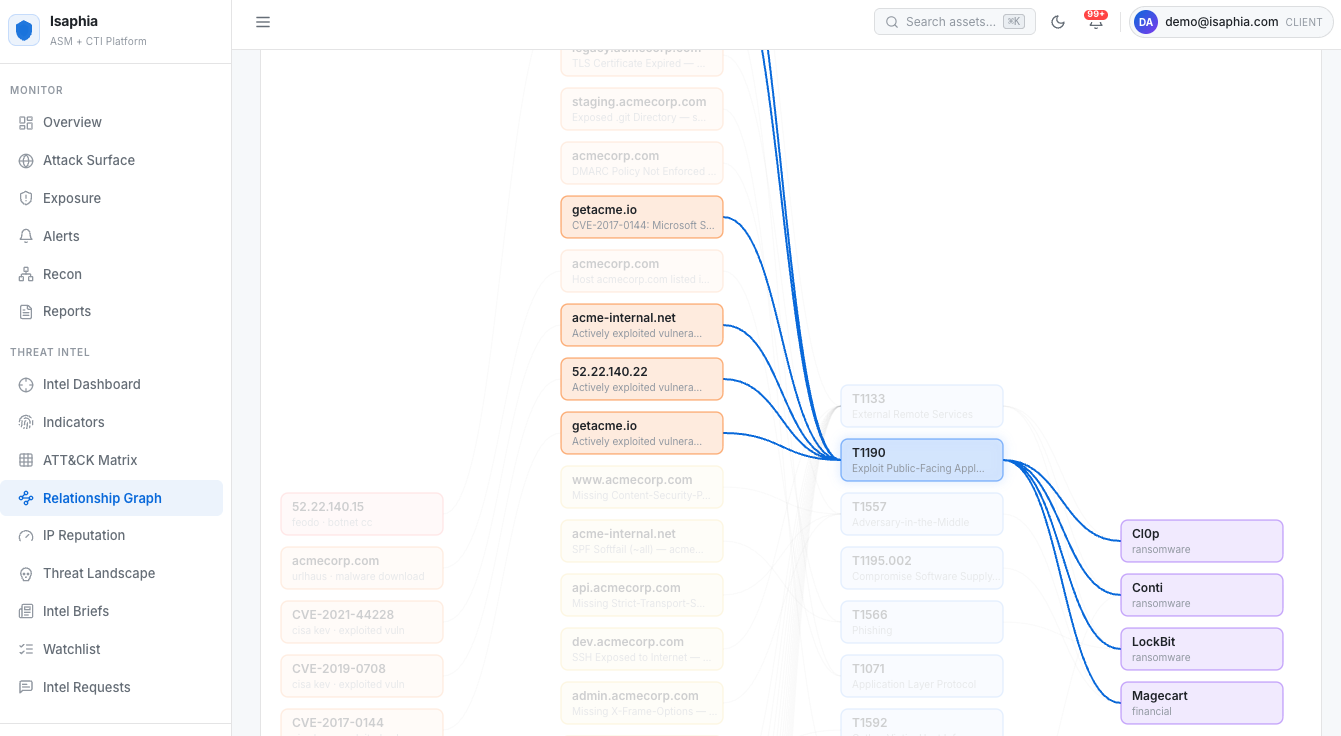 “One inventory” in practice: assets, findings, ATT&CK techniques, and threat actors connected in a single relationship graph.
Do I Need All Four?
No — and we’d rather tell you that plainly than pretend otherwise. The modules work independently, and most customers start with one. A company with no cloud footprint doesn’t need CSPM. A fully-remote startup with no office network may not need Internal ASM for years.
But every organization on the internet needs to know what it’s exposing, which is why External ASM is where almost everyone starts. The platform means that when you are ready for the next view, it’s a toggle — not a procurement cycle, a new vendor, and another console for your team to forget to check.
The Bottom Line
Attackers have never respected the boundaries between security product categories. They’ll happily chain a dark-web leak to a forgotten subdomain to an unpatched file server to a public bucket, because to them it was never four problems — it was one path.
Helios is that same path, seen from your side, before they walk it.
See What Helios Sees
You can see what’s exposed about your company right now, for free. No credit card. No sales call. Sign up, point it at your domain, and find out what attackers already see.
👉 Start your free trial at app.isaphia.com/signup
Or explore the platform first: Helios by Isaphia →
Helios by Isaphia is a unified exposure-management platform — External ASM, Internal ASM, CTI, and CSPM in one dashboard — that helps organizations discover, monitor, and protect everything an attacker could reach, before attackers exploit it.