Security has an acronym problem. EDR, XDR, SIEM, SOAR, IAM, ASM, CTI, ZTNA, CASB — most leadership teams nod along during vendor demos and walk out unsure which of those eighteen letters they actually need to budget for next quarter.
This post is about two of them: ASM and CTI. The reason we’re starting here is simple. Most of the other categories assume you already know two things — what you have on the internet, and what attackers think of it. ASM and CTI are how you find out.
Here’s what each one actually means, why every business should understand both, and what changes when you have them working together.
What is ASM (Attack Surface Management)?
Your attack surface is everything an attacker can see from the outside. The websites you host. The mail servers, login portals, file shares, dev environments, marketing landing pages, third-party tools, forgotten subdomains, expired SSL certificates, the random VM someone spun up for a vendor pilot two years ago and never shut down.
Attack Surface Management is the practice of continuously discovering all of that — and keeping it under control.
Sounds simple. It almost never is, for one reason that surprises most teams:
Your attack surface is always larger than your asset inventory. Often by a lot.
The IT spreadsheet that says you own 47 domains and 200 IPs is rarely wrong on the things it lists. It’s wrong on what it doesn’t list. Cloud accounts spun up by individual developers. Marketing landing pages registered under personal credit cards. Subsidiaries acquired without an IT integration step. Vendor portals branded with your name that you’ve never logged into. SaaS tools your sales team signed up for last week.
Every one of those is a door an attacker can knock on. None of them are in the inventory.
ASM, done properly, is the discipline of finding all of those doors — continuously, not as a one-time audit — and giving you a working map of what attackers can actually see. The same map they’re already building about you, except now you have it too.
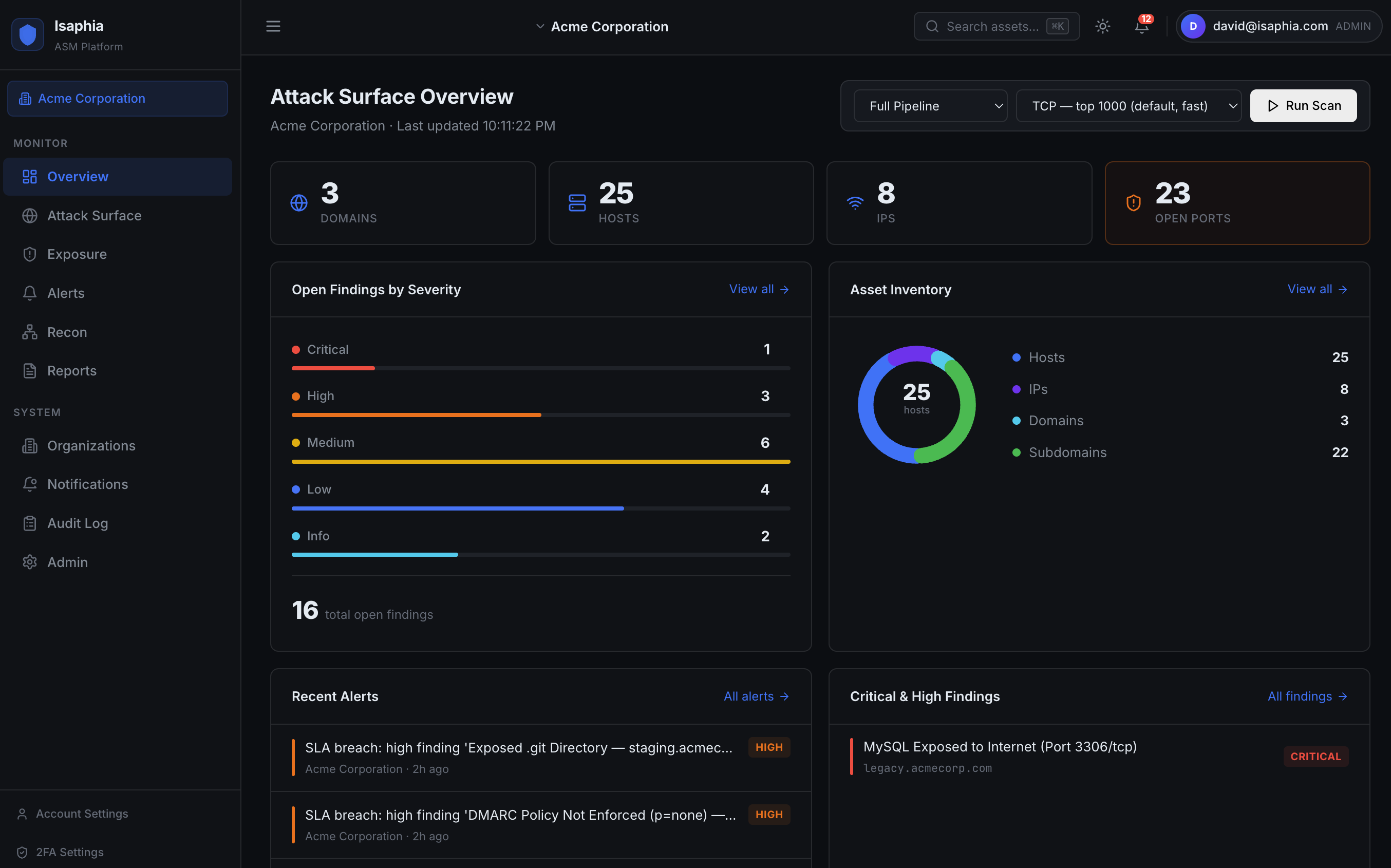 What ASM looks like in practice: a live map of everything you expose — one risk score, asset counts, and open findings by severity, with the critical items on top.
What is CTI (Cyber Threat Intelligence)?
If ASM tells you what you own, CTI tells you what the rest of the world knows about it.
Threat intelligence is the broad category of information about threats, threat actors, and the state of the internet around them. The useful, business-relevant slice of it looks like this:
- Reputation feeds. Is one of your IPs on a spam blacklist? Is a domain you own flagged as a phishing site? Are you sending traffic that other security tools quietly block?
- Leaked credentials. Have employee emails and passwords from your domain shown up in a recent breach dump?
- Dark web and underground mentions. Is your company name appearing in marketplaces selling access, on ransomware leak sites, or in target lists?
- Vulnerability and exploit chatter. Is a vulnerability in software you run being actively traded or exploited?
A lot of “threat intelligence” sold today is really just news — scary articles about attacks happening to other people. That’s not what we mean. Useful CTI is signal that maps to a specific thing you own, with enough context that you can make a decision. “Your IP 198.51.100.42 was added to Spamhaus yesterday” is signal. “Ransomware is up 30% globally” is news.
CTI on its own can feel academic. Lots of data, lots of feeds, lots of “interesting” but no clear action. The thing that makes it actionable is knowing what to map it against — which is exactly the job of ASM.
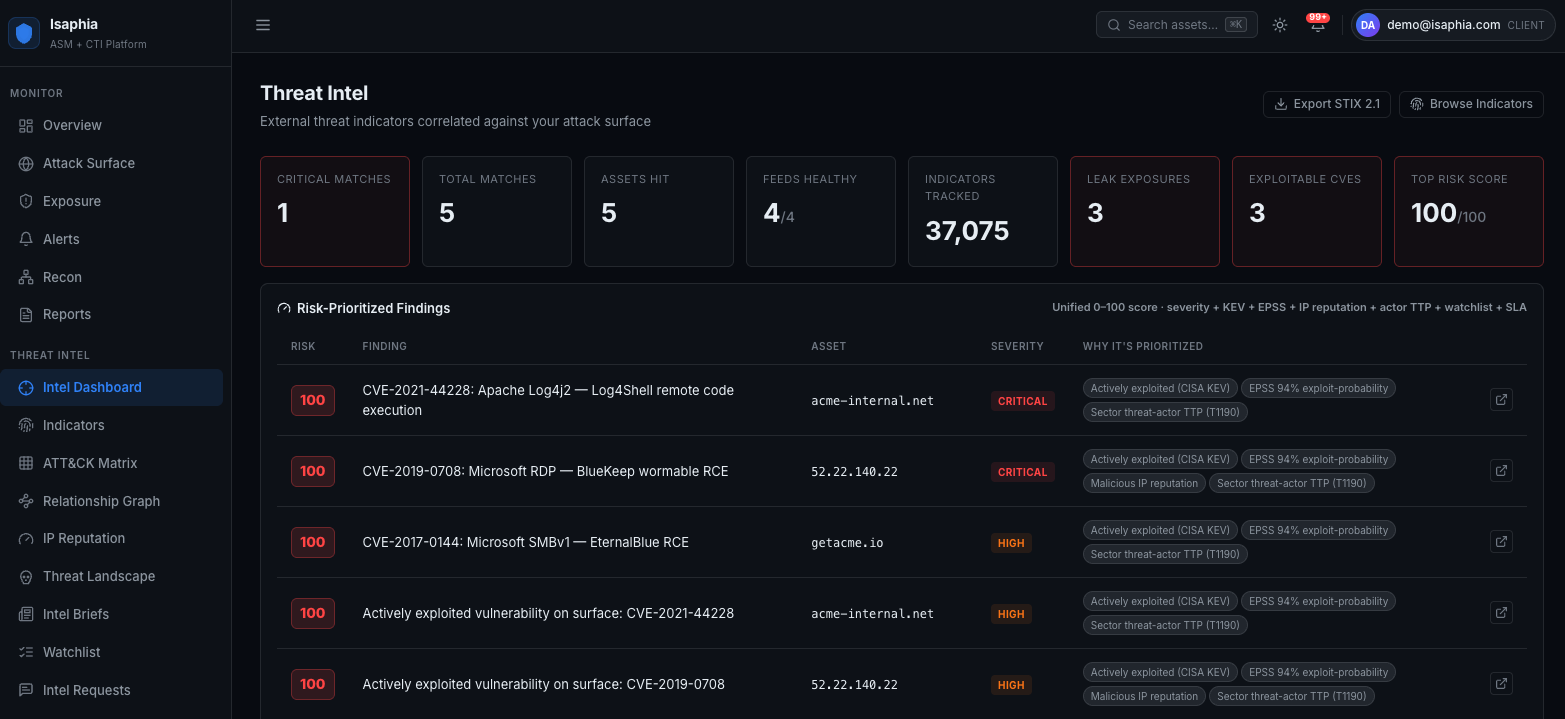 CTI done right: every indicator matched to a specific asset you own, ranked by risk — signal, not news.
Why You Need Both
Here’s the most important sentence in this post:
ASM tells you what you own. CTI tells you what attackers think of what you own.
Either one alone gives you half the picture.
- ASM without CTI: a complete map of your external footprint, with no context about which parts of it are flagged, exposed, leaked, or already being targeted.
- CTI without ASM: a firehose of “interesting” signals about threats and bad actors, with no way to tell which of them actually point at you.
Together, they’re how you go from guessing to knowing. A concrete example — the same one we explored in our last post on IP reputation damage:
Your sales team mentions that some outbound emails aren’t reaching customer inboxes. With ASM alone, you can see all your mail-sending IPs. With CTI alone, you can see that some IPs somewhere are on a blacklist — but you can’t tell which of them are yours. With both, you can immediately see that the IP your marketing automation tool uses was added to Spamhaus eight days ago, and that’s why sales emails are silently disappearing. Fix the underlying issue, request delisting, problem solved — in hours instead of months.
The same pattern repeats across every category of risk: leaked credentials, exposed dev environments, expired certificates, forgotten subdomains pointing at hijacked infrastructure. ASM finds what’s yours. CTI tells you which pieces are already being weaponized.
That’s not a “nice to have” combination. For most businesses today, it’s the foundation everything else sits on.
What to Do Next
If you’ve never had a clean picture of your external attack surface and what threat intel says about it, the fastest way to find out is to look — for free.
Isaphia ASM + CTI does both, in one place. Sign up, point it at your domains, and you’ll see your real attack surface and what the internet thinks of it within minutes. No credit card. No sales call.
👉 Start your free trial at app.isaphia.com/signup
Isaphia is an attack surface management and threat intelligence platform that helps organizations discover, monitor, and protect their external digital footprint — before attackers exploit it.